Why Squats Matter
If you could only do one strength move for the rest of your life, you’d be smart to pick the squat. It’s the kind of exercise that does heavy lifting for performance, aesthetics, and everyday function. Whether you’re chasing PRs, fat loss, better posture, or just want to move without creaking through a grocery store aisle, squats belong in your toolkit.
They hit the big muscle groups hard: glutes, quads, hamstrings, and core. Translation? More strength, more power, and more calorie burn, all in one move. But it’s not just about gym goals. Squatting well builds the kind of balance and mobility that makes daily tasks think stairs, lifting groceries, or picking up your kid feel less like chores and more like warm ups.
Bottom line: master the squat, and you’ve got a baseline for fitness that carries over just about everywhere.
Get Your Base Right
Start with the stance simple, but crucial. Feet should be about shoulder width apart, with toes pointed slightly out. Nothing extreme just enough angle to let your hips move naturally.
Next, brace your core like you’re about to take a punch. Not just for show this locks in spinal stability from the get go. It’s your built in back support. No crunching or hollowing, just a tight belt of tension all the way around your midsection.
Now line up the rest: chest up, shoulders pulled slightly back and down, and eyes facing straight ahead not at the ceiling, not at your feet. You’re setting a strong foundation. Get sloppy here, and everything else falls apart.
Master the Descent
Getting the downward phase of the squat right is essential not just for results, but also for avoiding injury. This is where your form can easily break down if you’re not intentional with your movement.
Hinge First, Not Down
Begin by pushing your hips back as if you’re sitting into an invisible chair behind you
This hip hinge engages your glutes and protects your knees
Find the Right Depth
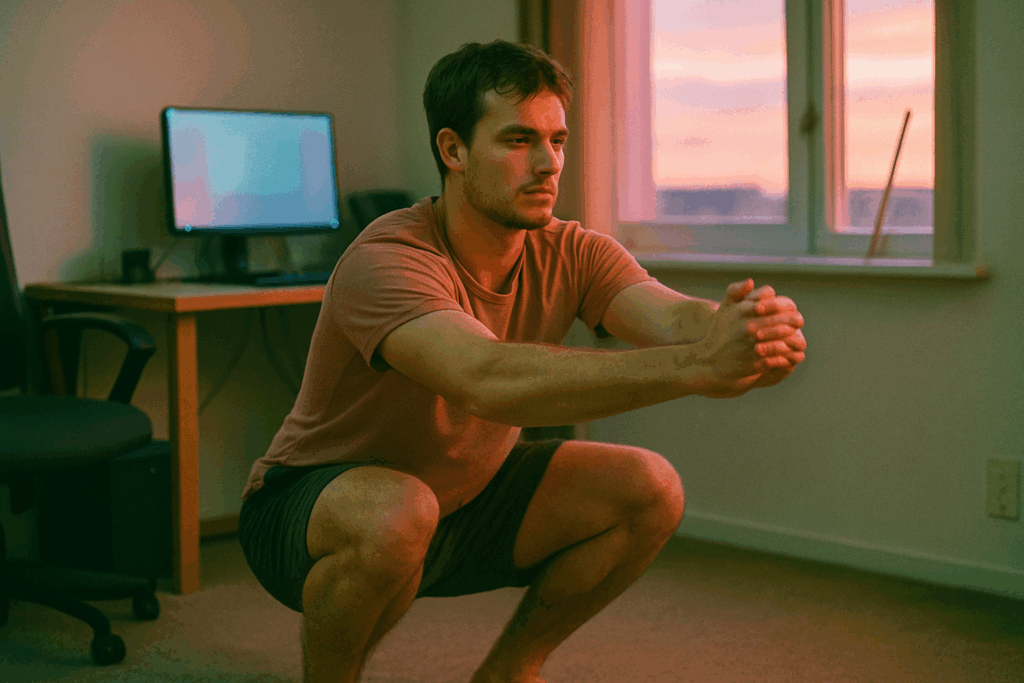
Lower your body until your thighs are at least parallel to the ground deeper is fine if mobility allows
Keep your chest lifted to avoid collapsing forward
Watch Your Knee Alignment
Your knees should follow the track of your toes throughout the descent
Never let your knees cave inward that’s a shortcut to injury, not progress
Anchor Your Weight
Keep your weight centered in your heels, not your toes
You should be able to wiggle your toes lightly at the bottom of your squat
Focusing on control and alignment during the descent sets you up for a powerful, safe return to standing. Prioritize form, not speed.
Drive the Ascent
Here’s the part where you power up. Stand tall by pushing through your heels not your toes. This keeps the stress on your glutes and hamstrings, where it belongs, and helps protect your knees. As you rise, squeeze your glutes hard at the top fire them like you mean it. That final contraction is where a lot of the strength (and the gains) gets locked in.
And don’t forget to breathe. Inhale on the way down to brace your core. Exhale on your way up to stay stable and strong through the ascent. It’s simple, but blowing out at the top keeps you steady when things get heavy.
Do this right, and every rep becomes a building block not just something to check off your list.
Common Mistakes to Dodge

Letting the knees cave inward
When your knees cave in during a squat, you’re putting unnecessary stress on the joints and unloading the glutes basically the opposite of what you want. Focus on driving your knees out in line with your toes throughout the movement. A resistance band just above the knees can help build the right motor pattern if this is a repeated issue.
Folding forward at the waist
A squat isn’t a deadlift. If you’re tipping too far forward, you’re likely shifting the load to your lower back. That’s a fast track to injury and weak glute engagement. Keep your chest proud and your core braced. Imagine someone’s tightening a belt around your midsection before you squat stiff and ready.
Rushing the movement or bouncing at the bottom
Speed kills form. Going too fast or bouncing at the bottom robs your muscles of tension and control. You should feel the depth not crash into it. Drop with intent, hit depth with control, and stand tall with power. Think tempo, not chaos.
Not going low enough to activate the right muscles
Half squats deliver half the results. If you’re not hitting parallel or lower, you’re leaving glutes and progress on the table. Depth might take mobility and some ego checking. But it’s non negotiable if you want strength that’s more than skin deep.
Add Progressions Wisely
Once you’ve nailed your squat form with just your bodyweight, it’s time to step things up. The key is to progress with intention adding resistance and variation without compromising technique.
Step 1: Start with Bodyweight
Ensure your form is solid before adding any load
Practice consistent depth and balance
Focus on quality reps, not speed or volume
Step 2: Introduce Resistance
Once you’re confident in your movement pattern, gradually increase the challenge:
Start with dumbbells or kettlebells held in front or at your sides
Advance to a barbell back squat when comfortable with alignment and stability
Use resistance only when your form can handle it poor form under load increases injury risk
Step 3: Add Variations for Strength and Control
To build even more control and muscle endurance, rotate in these advanced squat types:
Pause Squats: Add a 2 3 second pause at the bottom of each rep to improve stability
Tempo Squats: Slow your descent and ascent (e.g., 3 seconds down, 2 seconds up)
Bulgarian Split Squats: Elevate your rear foot behind you to challenge balance and isolate each leg
Golden Rule: Form Beats Load
No matter how heavy you lift, your top priority must remain form. Here’s why:
Clean movement patterns reduce injury and maximize results
Perfect reps with less weight are better than sloppy reps under load
Progression should support your goals not compromise your joints or spine
Build Smarter, Not Just Harder
Great squats alone won’t guarantee long term gains you need a balanced approach to your workouts. To build strength safely and effectively, pair smart programming with intentional recovery.
Complementary Moves to Level Up
Adding variety through functional, supporting exercises helps create total lower body strength and improves squat performance over time:
Hinge movements: Romanian deadlifts, kettlebell swings, or hip thrusts target the posterior chain (glutes, hamstrings)
Unilateral leg work: Lunges and Bulgarian split squats enhance balance and stability
Core focused accessories: Planks and anti rotation movements help reinforce core engagement during squats
The Power of Strategic Recovery
Pushing your limits is part of growth but doing it every session leads to plateaus or, worse, injury. Smart recovery helps you train more consistently and avoid burnout.
Rotate squat intensity across the week (light, moderate, heavy)
Schedule rest days or active recovery (walking, stretching, yoga)
Listen to fatigue levels quality work beats quantity
Before You Load Up… Learn the Basics
If you’re new to strength training or stepping up your program, revisit technique foundations before you start adding weight.
Prioritize movement quality over heavy loads
Understand proper breathing mechanics for safe lifting
Explore the full Strength Training Basics guide to build a strong, smart foundation
Final Form Check
Before you load the bar or increase your rep count, do a form check. These final cues can make the difference between an effective squat and one that leads to setbacks.
Keep a Neutral Spine
A properly aligned spine isn’t just about safety it’s about strength. A neutral spine allows for better power output and reduces risk of injury.
Keep your head in line with your spine avoid looking up or down
Don’t round your lower back at the bottom of the squat
Engage your core throughout to stabilize your torso
Watch Your Knees
Knee alignment is one of the most overlooked and most crucial elements of a solid squat.
Knees should always track in the same direction as your toes
Avoid letting them buckle inward, especially under load
Use a mirror or film yourself from the front to check alignment
Control the Tempo
Rushing through squats might add reps, but not results. A smooth, controlled pace engages more muscles and improves your ability to progress safely.
Lower on a 2 3 second count
Pause briefly at the bottom (maintain tension)
Drive up with purpose, but without bouncing
Bottom line: Good form isn’t optional it’s the foundation of progress. Slow things down, stay aligned, and let every rep count.
Want More?
If you’re serious about mastering strength training from squats to other key foundational lifts you don’t have to piece it together alone. We’ve got you covered with a full breakdown of essentials to build strength with confidence and proper technique.
What You’ll Find in the Full Guide:
Detailed tutorials on form for lifts like deadlifts, presses, and rows
Tips for beginners to avoid injury and build solid habits early
Progression strategies to safely increase load over time
Recovery and programming basics to support long term growth
Take the Next Step
Strength doesn’t happen by accident it’s built on smart, consistent effort. Start with the right knowledge base to lift safely and effectively.
Explore the full strength training basics guide to sharpen your technique across all your lifts.

 There is a specific skill involved in explaining something clearly — one that is completely separate from actually knowing the subject. Jones Dukensic has both. They has spent years working with health and wellness updates in a hands-on capacity, and an equal amount of time figuring out how to translate that experience into writing that people with different backgrounds can actually absorb and use.
Jones tends to approach complex subjects — Health and Wellness Updates, Nutrition and Diet Plans, Exercise Techniques and Guides being good examples — by starting with what the reader already knows, then building outward from there rather than dropping them in the deep end. It sounds like a small thing. In practice it makes a significant difference in whether someone finishes the article or abandons it halfway through. They is also good at knowing when to stop — a surprisingly underrated skill. Some writers bury useful information under so many caveats and qualifications that the point disappears. Jones knows where the point is and gets there without too many detours.
The practical effect of all this is that people who read Jones's work tend to come away actually capable of doing something with it. Not just vaguely informed — actually capable. For a writer working in health and wellness updates, that is probably the best possible outcome, and it's the standard Jones holds they's own work to.
There is a specific skill involved in explaining something clearly — one that is completely separate from actually knowing the subject. Jones Dukensic has both. They has spent years working with health and wellness updates in a hands-on capacity, and an equal amount of time figuring out how to translate that experience into writing that people with different backgrounds can actually absorb and use.
Jones tends to approach complex subjects — Health and Wellness Updates, Nutrition and Diet Plans, Exercise Techniques and Guides being good examples — by starting with what the reader already knows, then building outward from there rather than dropping them in the deep end. It sounds like a small thing. In practice it makes a significant difference in whether someone finishes the article or abandons it halfway through. They is also good at knowing when to stop — a surprisingly underrated skill. Some writers bury useful information under so many caveats and qualifications that the point disappears. Jones knows where the point is and gets there without too many detours.
The practical effect of all this is that people who read Jones's work tend to come away actually capable of doing something with it. Not just vaguely informed — actually capable. For a writer working in health and wellness updates, that is probably the best possible outcome, and it's the standard Jones holds they's own work to.